

Selling India… or Telling India’s Story?
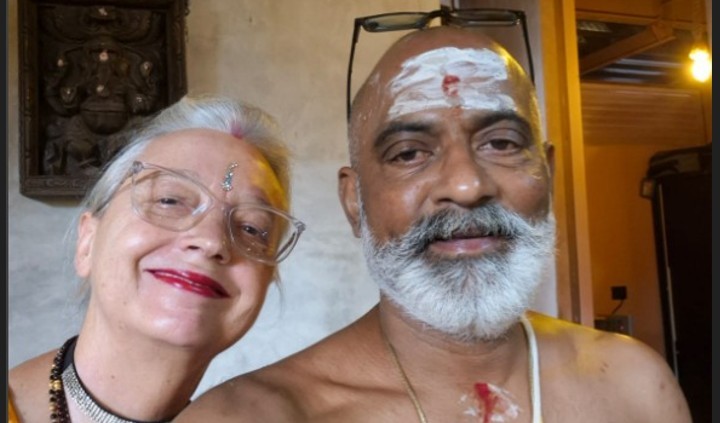
Véronique Narayana Swamy and Raghu Narayana Swamy in Kerala, illustrating nearly 30 years of shared experience, cultural immersion and authentic travel across India.
India tourism is entering a fascinating new chapter. A few days ago, I read a thought-provoking article by Amitabh Kant…
His message was clear.
India has extraordinary tourism potential.
It could welcome many more international travelers.
It deserves far greater global visibility.
I couldn’t agree more.
But after reading his article, another question stayed with me.
Is India’s biggest challenge still to be seen?
Or is it now to be understood?
When I first arrived in India in May 1995, social media didn’t exist.
No Google.
No Instagram.
No YouTube.
We travelled with a few guidebooks, a handful of documentaries, and a great deal of uncertainty.
To be honest…
I didn’t even want to come.
At five o’clock in the morning, the aircraft door opened directly onto the tarmac in Delhi.
A heat unlike anything I had ever experienced wrapped itself around me.
Then came the drive to the Vasant Continental Hotel.
And the men relieving themselves along the roadside.
At the time, I was managing a veterinary laboratory specialising in food hygiene.
Fecal coliforms were part of my everyday professional vocabulary.
Needless to say, this first encounter with India had nothing in common with a glossy tourism brochure.
Back then, we still told the stories of our journeys through postcards.
I wrote to my parents.
To my friends.
To my colleagues.
And one word kept coming back.
Indescribable.
Then another.
Impossible to define.
Impossible to fit into any category.
I searched for words.
And I couldn’t find them.
When I returned to France, nobody really understood what I was trying to explain.
Looking back, I don’t think I fully understood it myself.
I simply knew that no photograph was enough.
No story could truly capture what I had experienced.
A few days later, in Jaipur, an astrologer made me laugh.
A nervous laugh.
One I still remember nearly thirty years later.
At my request, Raghu—who at the time was neither my partner nor my husband, simply the director of the local agency—had arranged the meeting.
I’ve always been fascinated by the unknown.
Perhaps because I’ve always believed that science ends where certainty ends.
A friend was travelling with me.
At one point, our guide suddenly stopped translating.
The astrologer had just looked at my friend and said:
« You are a mother without being a mother. »
The guide was confused.
My friend was too.
I wasn’t.
She had adopted two children after being told she would never be able to have any.
She pulled her hand away and said,
« Let’s get out of here. »
And I started laughing.
Because if that was true…
Then perhaps everything the astrologer had just told me about my own life might also be true.
Looking back, the astrologer isn’t the important part of the story.
What matters is what he represented.
It was the first moment I understood that India stubbornly refuses to fit inside the categories we instinctively try to impose upon it.
Thirty years later…
India is everywhere.
On our screens.
On Instagram.
On YouTube.
In documentaries.
In international marketing campaigns.
It has never been more visible.
And yet…
I’m not convinced it is better understood.
Too often, we swing between two caricatures.
The India of chaos.
And the India of luxury.
Both exist.
Both are real.
Yet neither truly tells the story of the country.
Because India is never just one thing.
It is often several truths at the same time.
It can frustrate you in the morning…
And move you deeply by the afternoon.
It can leave you completely disoriented…
Before making you feel unexpectedly at home.
I often think about the Incredible India campaign.
It was a remarkable campaign.
It introduced millions of people to the country.
But it also leaves me wondering.
By showcasing India’s most spectacular places…
Have we forgotten to tell the stories that make India profoundly human?
The drivers.
The families.
The local guides.
The villages.
The unexpected conversations.
The encounters that quietly transform a journey.
The moments that will never appear in a brochure.
For almost thirty years, they are the ones who have told me what India really is.
Not the monuments.
Not the slogans.
People.
Among them, one person holds a very special place.
The man who first introduced me to his country.
Who shared his passion for India with me.
Who taught me to look beyond appearances.
My mentor.
Then my partner.
Then my husband.
Without ever trying to change who I was.
Without ever asking me to become someone else.
Understanding a country doesn’t mean becoming that country.
You can learn to love it.
To respect it.
To understand it.
While remaining entirely yourself.
After almost thirty years living in India, what amazes me most may not be India itself.
It is what India has taught me.
Resilience.
Adaptability.
The ability to begin again.
To keep moving forward when nothing goes according to plan.
One day, after returning from a trip to France, I was sitting on a plane waiting to take off from Paris.
And a thought crossed my mind.
« I’m going home. »
That was probably the moment I realised I was no longer looking at India through the eyes of the woman who stepped off an airplane in Delhi in May 1995.
So yes.
I agree with Amitabh Kant.
India deserves to be better known.
It deserves to welcome more travelers.
But I believe its greatest challenge is not simply to market itself better.
It is to tell its story better.
Real.
Complex.
Contradictory.
Sometimes unsettling.
Often surprising.
Profoundly human.
Because after nearly thirty years…
I still believe that India remains, in so many ways…
Indescribable.
And perhaps, before trying to show more of India to the world…
Perhaps we should begin with a far simpler question.
Tell me about India.
Inspired by a recent article by Amitabh Kant on India’s tourism potential.
About the Author
Véronique Narayana Swamy is the founder of BB Voyage Pvt Ltd and IndeXperience.
A French travel designer based in India since 2001, she specializes in immersive journeys across India, Nepal and Bhutan. Through her writing and field experience, she explores how travel can create deeper cultural understanding, meaningful encounters and lasting transformation.
About this article
Originally published in French on LinkedIn.
Read the original French version → https://www.linkedin.com/pulse/linde-doit-elle-%C3%AAtre-mieux-vendue-ou-racont%C3%A9e-narayana-swamy-z78bc
Inspired by a recent article by Amitabh Kant on India’s tourism potential.
Read Amitabh Kant’s article → To bring the world, sell India better: The $200 million fix India needs to unlock a tourism windfall – The Economic Times
